

Doomed Confessionary: Yaroslav Yakos (Fretting Obscurity)

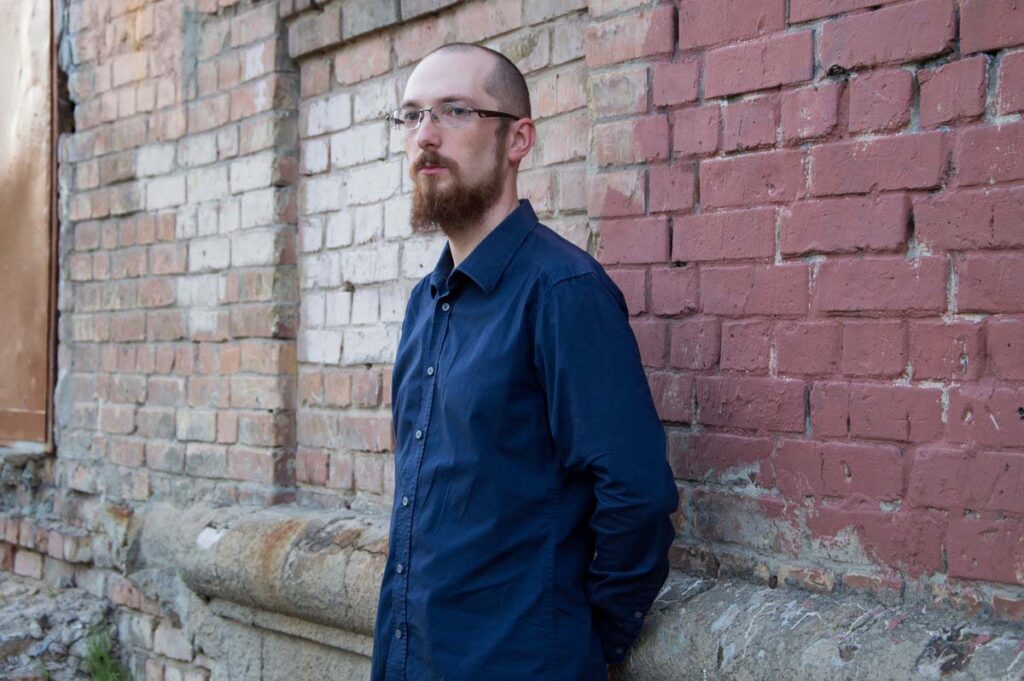
Fretting Obscurity is a funeral doom/death metal solo project by Yaroslav Yakos. Hailing from Kyiv, Ukraine, Fretting Obscurity was fully formed in 2017. It was then, influenced by existentialist literature, that Yaroslav finished working on his first demo. The first album »Flags In The Dust« came out a year later in 2018, received moderately positive reviews, and became the debut of the month on doom-metal.com.
Stylistically, Fretting Obscurity’s music belongs to those exemplary samples of funeral doom metal that arise from following the “three guitar canon” pioneered by the legendary Mournful Congregation. Characteristics of this style are an extreme tone and tempo (low&slow), the simultaneous sounding of two or three (sometimes more) leading guitars, and the predominance of melody and solo over riffs and rhythm.
Fretting Obscurity’s second album »Das Unglückliche Bewußtsein« was just released on May 10th, 2024 via French label Bitume Prods. The new album draws inspiration from the tragic worldview of pre-Socratic and classical German philosophy. It consists of four songs that set the poetry of classic European authors to 50 minutes of music in a style of flowing, melodic funeral doom. The musical canvas is complemented by oppressive inserts of doom-death, black, and post-metal, creating an atmosphere of existential uncertainty, helplessness, abandonment, and dark despair.
Can you say a few words about your band?
It’s a one-man band from Kiev, Ukraine. Genrewise, the group belongs to funeral-doom and doom-death. The ideological content is classical literature and philosophy, existentialism in particular. I started writing music more than 10 years ago. At first, I did it for myself and had no plans to publish anywhere. The idea to release a real album came towards the end of its recording. The music turned out to be quite complex compositionally, and so much work was put into recording the songs that I realized: there are a lot of well-known bands that release much worse music. That’s how my project appeared.
What was the biggest challenge for the band?
The hardest thing was to release the second album. Firstly, war broke out in the country and it came out almost two years later. Secondly – I was looking for a label for a very long time. I wanted to release the album as soon as possible – because at any moment I could find myself at the front and die. But most labels have a list of releases booked for years in advance. So the choice of the label was delayed, although this is exactly what I tried to avoid.
What can you be most proud of so far?
I have a rather high self-esteem, so in response to this question I will confine myself to the musical plane. Otherwise, this interview will turn into a philosophical treatise 🙂 For example, while I was sending my demo, I received several approving reviews about the new album from people who run several legendary labels in this genre. I will not name their names, as we communicated informally and, I think, it would be inappropriate to use them as advertising. But getting to know them and their recognition means a lot to me. I know how to distinguish when other people’s recognition is empty and when it’s justly deserved, so I highly treasure such cases.
What was your biggest regret?
Again, let’s stick to music. At the first minute of the first album, there’s a moment when the guitar noticeably lags behind the rest of the instruments and then shamelessly “catches up” in an amateurish way. This episode makes me facepalm. The thing is that I recorded this part when I did not take seriously what I was doing. And when I decided to finally release the album (as I said, this happened towards the end of recording the songs), I threw my hands up and didn’t want to rewrite. I like to leave some imperfections of the most obvious and most absurd, at first glance, character. However, this, to put it mildly, imperfection, does not please me. There are no such episodes on the second album.
What was the best concert/tour so far and why?
Fretting Obscurity is a studio band. I don’t have session musicians.
What was the biggest surprise on the music scene for you?
Nothing surprises me anymore. Life only surprises the blind. However, I remember when I was around 20, I was surprised to learn that the Japanese noise project Merzbow released an album on a Ukrainian label. Merzbow is a legend. Then I realized that the value of such a precedent is low – since Masami Akita has a million albums and he can afford to release them in batches in any country he wants.
What is currently in your heavy musical rotation?
I love, first of all, GOOD music. So I don’t always listen to metal. For example, I love Dungeon Synth (by the way, its influence can be heard on the fourth track of the new album). As for favorite bands, these are Metallica, Kreator, Mournful Congregation, Funeral (Nor), Bohren & Der Club Of Gore, Mourning Beloveth, Ophis, Saturnus. There are many other wonderful bands that cannot be left unmentioned, but which I did not mention because I do not want to count for a long time.
What was the best advice you’ve ever been given as a musician?
When we were 19, my friend Alexei (he is now at war), offered me to buy his electric guitar. I should say, neither he nor I could play well at that time. I refused to buy it, because I only had 700 hryvnias, (in dollars, this is probably a laughable amount), while at that time an electric guitar could be sold for 1000-1500 hryvnias. Eventually, Alexei contacted me and almost forcibly imposed this guitar on me for the money I could give for it. It’s the one you hear on the first Fretting Obscurity album. For those interested, it was an LTD M-50. I still have it, although I used a different one on the new album.
What are your guilty pleasures?
I like to watch anime. I’m not proud of it because it’s an escape from the unbearable real world to an invented one. But it is perhaps the only thing that gives me pure joy not tainted by anything serious. I think there are no more such things. At all.
Can you say something more about the music scene in Kyiv / Ukraine?
Yes, I can say that there are a lot of cool black metal bands in Ukraine. For example, the legendary Nokturnal Mortum (I love the albums from 1998-1999 the most). Once I was asked if I belong to the Kiev doom scene or stand separately. Then I answered like: “I didn’t even know that there is some kind of Kiev doom scene.” I still think so. The situation with extreme doom in Ukraine is bad, not including a few performers and albums like »O’Funeralia« (from the Autumnia band) and two Te Deum LPs. The rest is occasional good music, but there is little of it overall. And I’ll add more: there is little good doom in the whole world, and very little good funeral-doom.
Where can we see you live this year?
This year I’m going to war, I’m preparing and studying the necessary skills.
What are your plans for the future as a band?
Previously I did not want this, but now I want to have a live performance. If I return from the war, I will try to make this a reality.
How can people best support your band?
You can write a few words to my email: fr****************@***il.com. I do not promise that I will reply – by that time I might be dead already. Haha.
Do you have any message for your listeners?
No, I don’t. Everything is vanity of vanities. Whatever I would say, everything has already been said earlier by other people, everything will be forgotten and nothing will be retained for future generations. It’s not a beautiful phrase. It’s a fact. The beauty is in not taking it seriously and doing spectacular nonsense, Byron-style. Well, a message to the listeners turned out, although I didn’t intend to write one 🙂
Links:
Bandcamp | Bitume Bandcamp | Spotify
Bojan Bidovc // music enthusiast, promoter, misanthrop and sometimes a journalist as well