

American funeral doom metal solo project Abyssal Liturgy released debut album »Lamentations Of The Desolate«; out now on CD and digital!
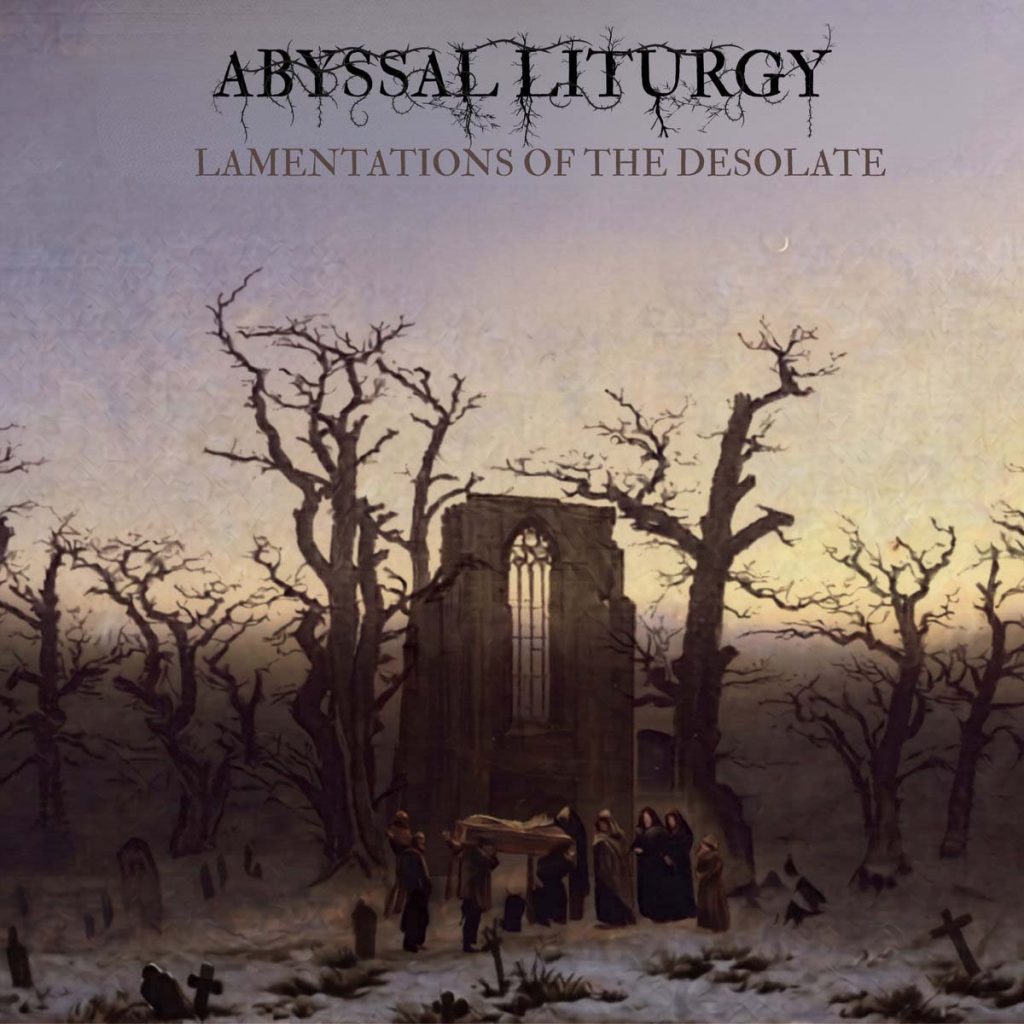
American funeral doom metal solo project Abyssal Liturgy has released debut album »Lamentations Of The Desolate« on May 22nd, 2026 in digital format. The album was reissued on CD on June 15th, 2026 via GS Productions.
Listen to »Lamentations Of The Desolate« on Bandcamp and Spotify!
Tracklist:
01. Apophis
02. Endless And Formless
03. The Infinite Decay Of The Abyssiverse
04. Lamentations Of The Desolate
05. A Murder Of Crows Keeping Watch Over The Graves Of The Fallen
Abyssal Liturgy is a funeral doom project with cinematic influences-based out of Venus, Texas.
All songs composed, performed and mixed by Greg Ritchey (Silent Deep Ocean). Mastered at Abyssopelagic Studios.
I. Album Manifesto
We must define things not as they are, because our perceptions are rendered mute by our internal struggle to define ourselves. When we sit in complete darkness, the light – while physically absent – glows brightly, so long as we surrender to the One: that ineffable source, unknowable, without origin, and completely anachronistic.
We cannot define the One by conventional means; not by intellect, not by academia, and not by philosophy. The One shows itself by silence – by being completely immersed in the ocean of silence, where time ceases to exist and all things, present and past, converge.
II. The Existential Burden (Introduction)
»Lamentations Of The Desolate« is essentially a journey into entropy – a journey into dissolution where time, plot, and memory decay into one amorphous amalgamation of nothingness. For everything is spiralling downward to an inevitable conclusion, and we are powerless against it.
This release was tentatively entitled Apophasis, which is rooted in negative theology: defining the divine only by what it is not. But I found myself wanting to delve deeper into a crucial existential factor. What I have not mentioned so far is this: we possess the ability to remove ourselves from the downward spiral. We have the ability to pull the nine-inch nails from our own palms and set ourselves free.
And that is the true burden of freedom – the crushing burden of existence. We do not want to be free. We are comfortable in our suffering. We are comfortable in our pain because it is familiar to us. It is the unknown that scares us to death.
III. Thematic Influence: On The Presentment Of Grief
“I measure every Grief I meet
With narrow, probing, Eyes
I wonder if it weighs like Mine
Or has an Easier size” — Emily Dickinson (Poem 561)
The inclusion of Emily Dickinson’s Poem 561 is not a decorative literary addition; it is the very architectural lens through which »Lamentations Of The Desolate« must be navigated. Dickinson was a master of absolute isolation, transforming the quiet confines of her room into an analytical chamber for the human soul. She did not merely feel sorrow – she weighed it, measured it, and scrutinized it with “narrow, probing, eyes.”
This album approaches funeral doom with that exact same severe, calculating discipline. In a genre that often surrenders to theatrical or romanticized despair, these tracks serve as an objective measurement of the void. When the tempos drop to a glacial crawl and the heavy low-end density threatens to overwhelm the listener, the music is physically calculating the gravity of existence.
Furthermore, Dickinson’s lingering question – “I wonder if it weighs like Mine / Or has an Easier size” – captures the central alienation of the Desolate. It represents the quiet, agonizing curiosity of the solitary wanderer looking out from the abyss, trying to map the unseen boundaries of another’s suffering. By burying the vocals deep within the dense walls of orchestration and distortion, the voice becomes the sonic manifestation of Dickinson’s “disembodied ghost” – a distant, searching presence trying to gauge its own fractures against an indifferent cosmos. We print these lines because they provide the precise frequency of our lamentation: a cold, metric gaze into the heaviest depths of the spirit.
IV. The Movements (Track-By-Track)
1. Apophasis (15:00)
As the opening movement, Apophasis functions as a stark, unyielding threshold into the void, utilizing a severe and minimalist funeral doom structure to establish the album’s weight. The track strips away any symphonic ornamentation to let the sheer mass of the instrumentation speak for itself. It begins not with melody, but with a profound, suffocating low-end presence – glacial chord progressions and devastating rhythms that alter the listener’s perception of time. The vocals are deliberately buried deep within the dense walls of down-tuned guitar distortion, acting as a distant, atmospheric layer of dark fog rather than a lyrical center. By forcing the listener to confront fifteen minutes of pure, unadorned sonic gravity, Apophasis perfectly executes its theological namesake: defining the absolute vacuum by stripping away everything else.
2. Endless And Formless (11:47)
A continuation of track one, the title was written to accent the ambiguity of reality. What is something that has no end? Life? Death? Grief? The One shows itself by silence – by being completely immersed in the ocean of silence, where time ceases to exist and all things, present and past, converge. The Ocean of Silence is one such entity: endless, formless, and elusive in nature, opening with cold, spacious synth pads that establish a vast, drifting atmosphere before the heavy instrumentation takes over.
3. The Infinite Decay Of The Abyssiverse (13:31)
A common theme in this exploration is one of entropy – the theory that all things are spiralling downward to an inevitable conclusion. It is the collapse of time itself. Driven by a profound, prominent piano melody that cuts through the massive low-end weight, it serves as the emotional and melodic anchor for the entire track. Conversely, the Abyssiverse will never truly disappear, for as the immortal saint Emerson has written in his essay Circles: “Under every deep a lower deep opens.”
4. Lamentations Of The Desolate (17:04)
A cry of a disembodied ghost in the shadows – a raven calling out to the void atop its perch on a weathered tombstone – the absolute anguish of Orion as she is eclipsed by Betelgeuse: these are all laments to a realm where their cries echo for all eternity.
The Desolate are those whose souls have broken into innumerable shards, never to be whole. The Desolate are the wanderers of creation, ghosts whose bodies lie in the ruins, several thousand leagues to the West. They lament their sins and shattered dreams, kneeling in emptied spaces where time and memory have left. Features a dedicated orchestral section right in the middle, stripping away the heavy guitars to let the strings and choir fully breathe before plunging back into a devastating, slow-motion funerary climax.
5. A Murder Of Crows Keeping Watch Over The Graves Of The Fallen (15:17)
Long seen as the protectors, messengers, and tricksters of the divine, crows serve a distinct purpose in mythology. They exist entirely on the border between the living and the dead, acting not merely as birds, but as watchful mediators of the crossing. In this final movement, they become the “Grave Sentinels” – the sole, eternal witnesses to a tragedy that has already occurred, keeping an ominous vigil over a loss that can never be undone.
Cover art: The Abbey in the Oakwood (1809–1810) by Caspar David Friedrich.
A seminal work of German Romanticism, Friedrich’s painting captures the exact visual architecture of this liturgy: a winter procession of monks bearing a coffin into the ruins of a Gothic monastery, framed by gnarled, leafless oaks. It serves as a silent, timeless monument to the very themes of entropy, mourning, and the vast, cold transition between existence and the void that this music seeks to explore.
Bojan Bidovc // music enthusiast, promoter, misanthrop and sometimes a journalist as well